Role of AR and VR in Business
The integration of augmented reality (AR) and virtual reality (VR) in business is reshaping traditional practices across various sectors. These technologies enhance customer engagement through immersive experiences and transform training methodologies by providing realistic simulations. Moreover, they streamline operations and enable innovative marketing strategies. As businesses adopt AR and VR, the implications for customer relationships and operational efficiency are profound. What remains to be explored are the long-term effects of these advancements on industry dynamics.
Enhancing Customer Engagement Through Immersive Experiences
As businesses increasingly seek innovative ways to connect with consumers, augmented reality (AR) and virtual reality (VR) have emerged as pivotal tools for enhancing customer engagement.
Virtual showrooms allow customers to explore products in lifelike settings, while interactive storytelling captivates audiences by immersing them in narratives.
These technologies not only foster deeper connections but also empower consumers with the freedom to experience brands uniquely and personally.
Read Also: Nanotechnology Explained
Revolutionizing Training and Development in the Workplace
Transforming traditional training methods, augmented reality (AR) and virtual reality (VR) are redefining the landscape of workplace development.
These technologies enable immersive virtual simulations that allow employees to practice real-world scenarios safely.
Furthermore, AR and VR facilitate dynamic skill assessments, providing instant feedback and personalized learning experiences.
This innovative approach fosters greater engagement, efficiency, and adaptability, essential for a workforce seeking freedom in their professional growth.
Streamlining Operations and Improving Efficiency
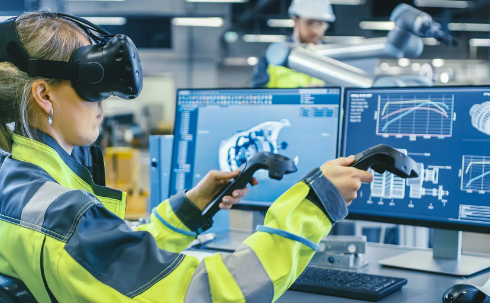
While many businesses struggle to optimize their operations, the integration of augmented reality (AR) and virtual reality (VR) technologies offers a promising solution for enhancing efficiency.
By leveraging AR and VR for process optimization, companies can improve data visualization, enabling better decision-making.
These technologies help streamline workflows, reduce errors, and ultimately lead to a more agile and responsive business environment.
Creating Innovative Marketing Strategies With AR and VR
The integration of augmented reality (AR) and virtual reality (VR) technologies is not only streamlining operations but also reshaping marketing strategies for businesses.
By utilizing virtual showrooms, companies can offer immersive experiences that allow customers to interact with products in real-time.
Additionally, interactive advertisements engage users more deeply, fostering a sense of connection and enhancing brand loyalty, ultimately driving sales and customer satisfaction.
Conclusion
As businesses navigate the digital frontier, the integration of AR and VR stands as a beacon of innovation, akin to the advent of the printing press in its transformative potential. By enhancing customer engagement, revolutionizing training, streamlining operations, and crafting unique marketing strategies, these technologies are not merely novelties but essential tools for modern enterprises. Ultimately, the effective deployment of AR and VR will shape the future landscape of business, fostering deeper connections and driving sustainable growth.